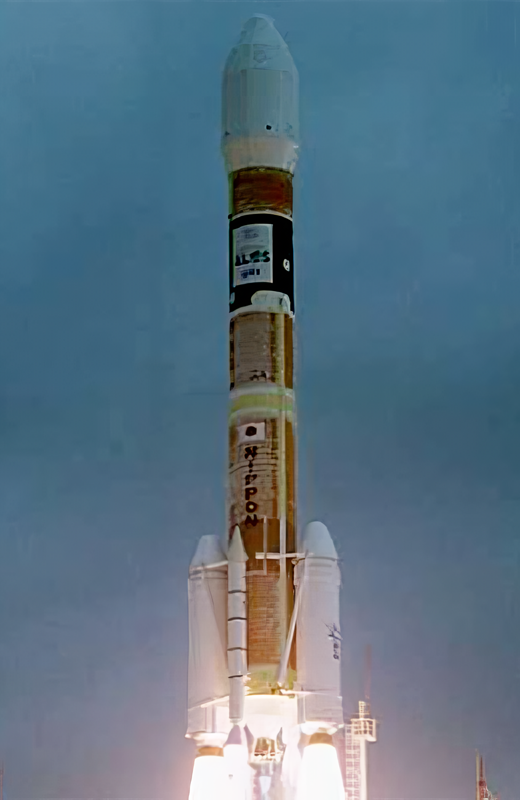
H-IIA 2022 | Daichi
Status: Success | Launched: Jan 24, 2006 01:33 UTC
Launch Provider & Rocket
- Provider: Japan Aerospace Exploration Agency (Government)
- Rocket: H-IIA 2022 — H-II family
Mission
ALOS (Advanced Land Observation Satellite) is used for cartography, regional observation, disaster monitoring, and resource surveying. ALOS has three remote-sensing instruments: - the Panchromatic Remote-sensing Instrument for Stereo Mapping (PRISM) for digital elevation mapping with 2.5 meter resolution, - the Advanced Visible and Near Infrared Radiometer type 2 (AVNIR-2) for precise land coverage observation with 10 meter resolution, and - the Phased Array type L-band Synthetic Aperture Radar (PALSAR) for day-and-night and all-weather land observation. ALOS transmitts its data via the DRTS (Kodama) satellite. The ALOS was launched by an H-2A-2022 launch vehicle from the Tanegashima Space Center. ALOS as been given the nickname Daichi. Five minutes after spacecraft separation, ALOS began to unfurl its 72-foot solar array that will provide electrical power to the craft throughout its mission. Six cameras are on-board to visually verify the correct deployment of the solar panel and various instrument antennas. ALOS lost all power on 22. April 2011, thus ending the mission.
- Type: Earth Science
- Orbit: Sun-Synchronous Orbit (SSO)
Launch Site
- Pad: Yoshinobu Launch Complex LP-1
- Location: Tanegashima Space Center, Japan
- View on map
Launch data sourced automatically from the Launch Library 2 API. Last refreshed: 2026-10-07T01:00:56.820087+00:00.