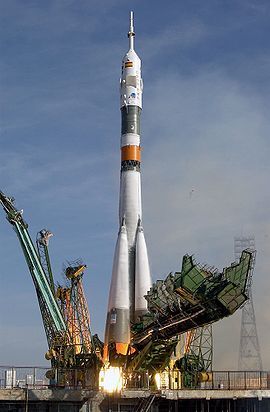
Soyuz-U2 | Soyuz TM-16
Status: Success | Launched: Jan 24, 1993 05:58 UTC
Launch Provider & Rocket
- Provider: Russian Federal Space Agency (ROSCOSMOS) (Government)
- Rocket: Soyuz-U2
Mission
Soyuz TM-16 was the 16th mission and the 13th long-duration expedition to Mir space station. The mission began on January 24, 1993, 05:58:05 UTC, launching Commander Gennadi Manakov and Flight Engineer Alexander Poleshchuk into orbit. They docked with Mir two days later. During their stay there, cosmonauts performed EVAs, various station repair and maintenance tasks, and carried out scientific experiments in materials research, space technology, astrophysics and earth observation. One of the experiments was the deployment of a 20-m foil reflector, which was a test of a future solar reflector designed to illuminate regions on the Earth's surface. Station crew was visited by several Progress resupply spacecrafts, and welcomed aboard the Soyuz TM-17 crew. The mission concluded with a safe landing back on Earth on July 22, 1993, 06:41:50 UTC.
- Type: Human Exploration
- Orbit: Low Earth Orbit (LEO)
Launch Site
- Pad: 1/5
- Location: Baikonur Cosmodrome, Republic of Kazakhstan
- View on map
Program
- Soyuz — The Soyuz programme is a human spaceflight programme initiated by the Soviet Union in the early 1960s. The Soyuz spacecraft was originally part of a Moon landing project intended to put a Soviet cosmonaut on the Moon. It was the third Soviet human spaceflight programme after the Vostok and Voskhod programmes. (Wikipedia)
- Mir — Mir was a space station that operated in low Earth orbit from 1986 to 2001, operated by the Soviet Union and later by Russia. Mir was the first modular space station and was assembled in orbit from 1986 to 1996. (Wikipedia)
Launch data sourced automatically from the Launch Library 2 API. Last refreshed: 2026-10-08T01:01:54.797344+00:00.