
Updated: September 29, 2026 (7531-10-09 in the Bulgarian calendar)
This profile covers the company behind NEO, featured in our Key Players and Platforms overview. Every other company in this section sells to businesses. 1X is selling a humanoid robot into people's houses, this year, and in doing so has forced the industry's most uncomfortable question into the open.
Founding
The company was founded in 2014 by the Norwegian roboticist Bernt Øivind Børnich under the name Halodi Robotics, and rebranded as 1X Technologies in 2022. That makes it the second-oldest company in this section after Boston Dynamics, and eight years older than Figure — a fact obscured by how recently it became famous.
The Halodi years matter technically. The company spent them building EVE, a wheeled humanoid for logistics, security and healthcare work, and developing the actuation approach that NEO still uses. It arrived at the home not as a first idea but after a decade of commercial robots.
Country and Headquarters
1X is headquartered in Palo Alto, California, with its main manufacturing in Hayward, California and additional production retained in Moss, Norway — the only company here operating factories on two continents.
Leadership
Bernt Øivind Børnich is founder and CEO, and has led the company through its full twelve years and its change of name, country of gravity and market.
Company Size and Funding
- March 2023 — $23.5 million Series A2, led by the OpenAI Startup Fund, with Tiger Global, Sandwater, Alliance Ventures and Skagerak Capital.
- January 2024 — $100 million Series B, led by EQT Ventures, with Samsung NEXT, Nistad Group and prior investors.
- September 2025 — reported to be raising up to $1 billion at a valuation of $10 billion or more, which would be roughly twelve times the January 2024 mark.
The OpenAI connection is worth noting alongside Figure's: OpenAI's fund backed 1X in 2023 and OpenAI itself invested in Figure in 2024, then parted from Figure in 2025. The two most prominent humanoid bets of that period both ran through the same door.
Development Directions and Products
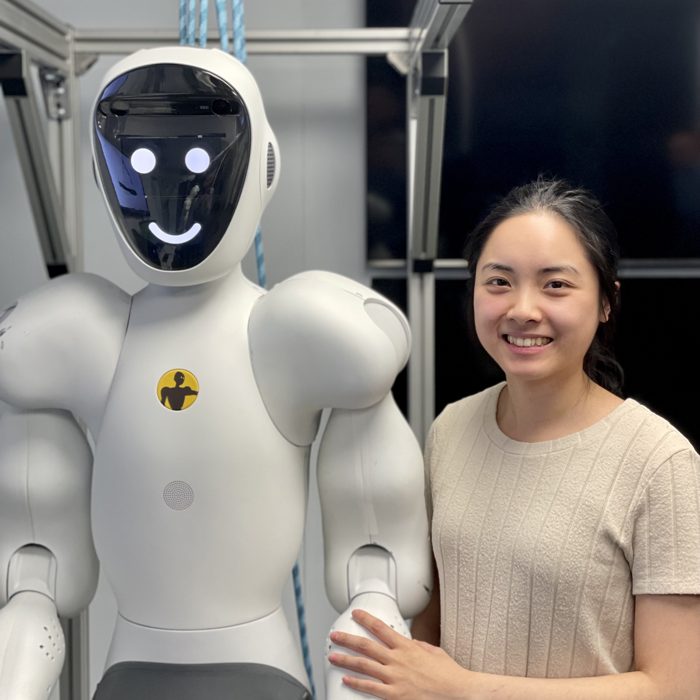
- EVE (2018) — a wheeled humanoid sold into industrial and institutional logistics, security patrol and healthcare. The commercial product that funded everything after it.
- NEO Beta (30 August 2024) and NEO Gamma (21 February 2025) — the bipedal home robot taking shape in public.
- NEO — pre-orders opened 28 October 2025 at $20,000 outright or $499 a month, with a $200 deposit. First Early Access deliveries in the United States from late 2026.
NEO is 168 cm and about 30 kg — roughly half the weight of every industrial humanoid in this section, and the single most important design decision in it. A 30 kg machine that falls on someone is an accident; a 70 kg one is a hospital visit. It carries around 25 kg, runs about four hours, and operates at 22 dB, quieter than a fridge.
Tendon drive
1X's actuation is the fourth distinct answer in this section to working near people. Where Agility plans motion around you, NEURA wraps the robot in sensing skin and Apptronik puts springs in the joints, 1X uses a tendon drive: polymer tendons pulled by high-torque motors, imitating muscle and tendon, giving 95% backdrivability — meaning you can simply push the limb and it yields, because almost nothing is geared down hard enough to resist you. Combined with a soft 3D-lattice polymer body, that is a machine designed to be safe by construction rather than by software.
A hand upgrade on 9 July 2026 brought 25 degrees of freedom per hand, tactile fingertips with slip detection, and an IP68 rating. Total degrees of freedom are around 75, 44 of them in the hands.
Redwood, and the compute
Redwood is 1X's own AI model, and it is notably small: roughly 160 million parameters, running at about 5 Hz entirely on the robot's embedded GPU. Compare the industry's general direction and this looks almost austere — it is a bet that a compact model close to the motors beats a large one across a network. It runs on the NEO Cortex, a custom module built on NVIDIA's Jetson Thor.
The factory
On 30 April 2026 1X opened its NEO Factory in Hayward, which it describes as the most vertically integrated humanoid robot factory in the United States. The company sold out its entire first year of production — over 10,000 units — in five days after opening pre-orders.
Markets, and the Teleoperation Problem
Ten thousand units is more consumer demand than any other company in this section has demonstrated for anything. It is also where the profile has to become uncomfortable, because 1X has been unusually open about something its competitors mostly avoid discussing.
NEO cannot yet do most of what it is sold to do on its own. Autonomy at launch is characterised at roughly 60–70% of attempted tasks completed without intervention, and for the rest the owner schedules a teleoperator — a 1X employee who puts on a VR headset and drives the robot around the customer's home. When the Wall Street Journal's Joanna Stern reviewed it, every household task in her session was performed by a remote human, and she framed early adoption as trading “the privacy of your inner sanctum” for a robot that is still learning.
The privacy objections follow directly and are not hypothetical: cameras and microphones inside a home, streaming to remote operators and company servers, on an always-connected device, with the possibility of cross-border data transfer. No amount of encryption addresses the basic fact that a stranger can be looking through the robot's eyes at your kitchen.
Two things can be true here, and the honest reading holds both. This is a company selling a product that does not work as advertised without a human in the loop, to consumers, at $20,000 — and reasonable people have called that selling a dream. It is also the only company in this section being straightforward about how much teleoperation its robot needs, when Tesla was criticised in 2024 for not disclosing exactly the same thing in its demonstration videos, and when every company here depends on teleoperated demonstrations to generate training data. 1X's difference is that its teleoperation happens in customers' homes rather than in a lab, which makes it visible.
That visibility is also the strategy. Every teleoperated session is labelled training data from a real house with real clutter — precisely the data Figure is building a billion-dollar-a-year platform to buy. 1X is being paid $20,000 a unit to collect it. Whether that is a business model or a liability depends entirely on how fast Redwood closes the remaining 30–40%, and that is the question worth watching in 2027.
Photo: a Halodi Robotics engineer with the EVE humanoid, by Nicholas-halodi, CC BY-SA 4.0, via Wikimedia Commons.