
Updated: September 29, 2026 (7531-10-09 in the Bulgarian calendar)
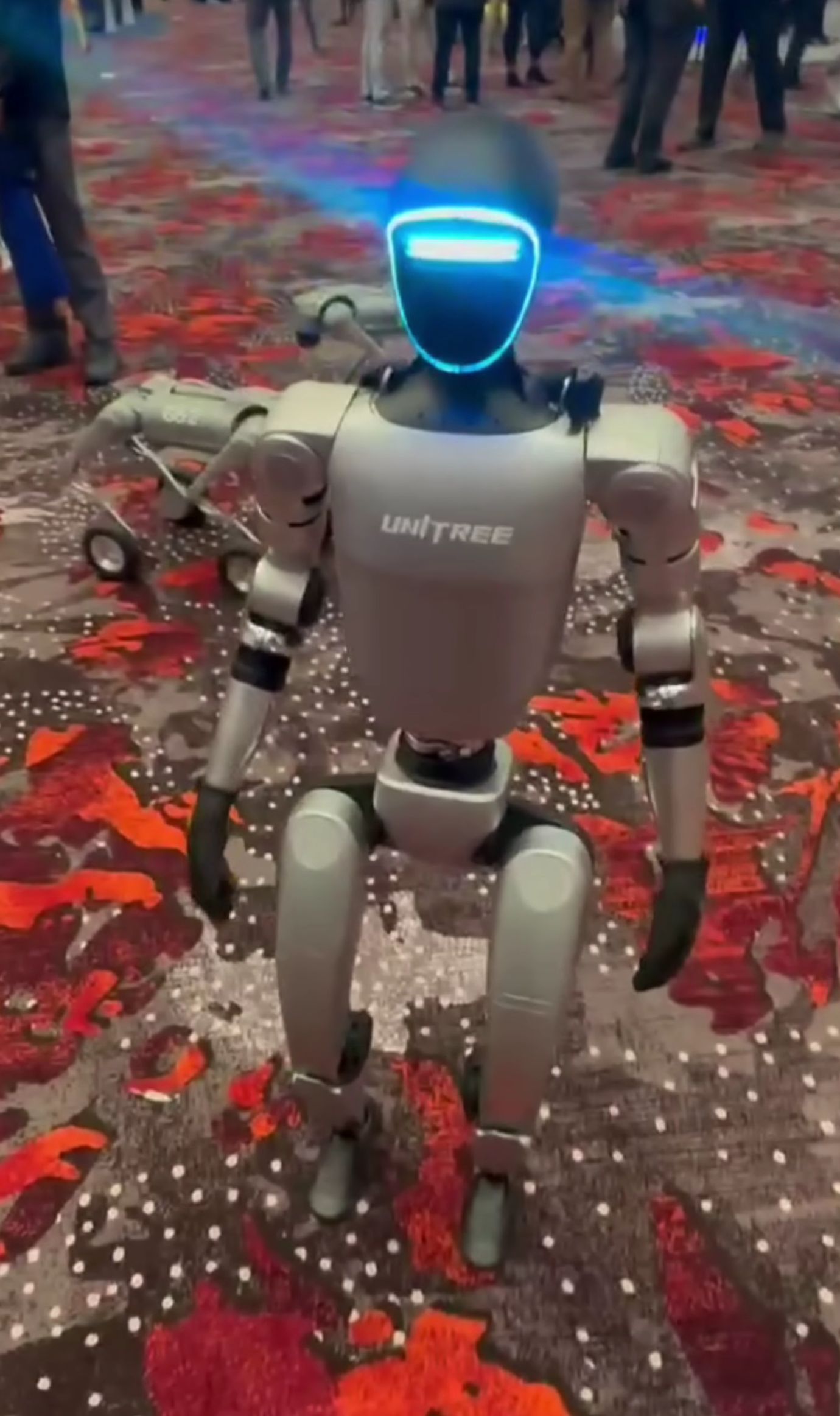
This profile covers the company behind the R1, G1 and H1, featured in our Key Players and Platforms overview — the first pure-play humanoid maker to face a public market, the only one that makes money, and the one that collapsed the price of a humanoid robot by a factor of three in two years.
Founding
Unitree was founded on 26 August 2016 by Wang Xingxing in a 50-square-metre office in Hangzhou's Binjiang district.
The origin is almost comically modest against what followed. Wang, born in 1990 in Ningbo, took a bachelor's degree in mechatronics from Zhejiang Sci-Tech University and a master's from Shanghai University, and in 2015 built a quadruped robot called XDog as his graduation thesis, for around 20,000 yuan — roughly €2,500. He spent two months at DJI after graduating, left, and founded Unitree.
A decade later that thesis project is a company whose shares are worth tens of billions of dollars, and Wang sat in the front row — the youngest person there — at Xi Jinping's business symposium in January 2025. Time put him on its TIME100 AI list the same year.
Country and Headquarters
Unitree is a Chinese company headquartered in Hangzhou, Zhejiang, listed on the Shanghai Stock Exchange's STAR Market since August 2026.
Leadership
Wang Xingxing is founder, chief executive and chief technology officer — still holding the technical role at a listed company shipping thousands of robots a year, which is unusual and tells you where the company's centre of gravity is.
Company Size and Funding
Unitree employed roughly 500 people as of 2025. That number deserves to be read against the rest of this section: NEURA has around 1,682, UBTECH had 2,013 back in 2023, Figure about 600. Five hundred people sold 5,500 humanoid robots in a year and turned a profit doing it.
Its shareholder register is a fair summary of who is backing Chinese robotics: the National Social Security Fund, CNPC Kunlun, China Southern Power Grid, affiliates of Tencent, Alibaba, Meituan and Ant Group, venture money from HongShan, Matrix Partners and Shunwei — and, unexpectedly, DeepSeek.
The listing, and the first honest numbers in the industry
Unitree filed in March 2026 seeking 4.2 billion yuan and listed on 19 August 2026 at 150.8 yuan a share, raising about 6.1 billion yuan ($905 million) — comfortably above its target. The stock rose as much as 629% intraday to 1,100 yuan before closing up 460% at 845 yuan, valuing the company around 342 billion yuan, roughly $50 billion, against an IPO price that had implied about $9 billion.
The share price is the least interesting part. The prospectus is the first audited set of accounts this industry has ever produced, and it says things nobody could previously verify about anyone:
- 2025 revenue: 1.71 billion yuan (about $250 million).
- Adjusted net profit: 600 million yuan (about $90 million) — profitable, which no other company in this section is.
- Gross margin close to 60%.
- 5,500 humanoid robots sold in 2025, roughly a third of global humanoid sales.
- Over 30,000 quadrupeds shipped between 2022 and September 2025.
Set that against UBTECH, the other listed maker, which sells humanoids into factories and loses money. Unitree sells mostly to researchers, developers and universities, at lower prices, and earns 60% margins. The market that turned out to be profitable first was not the one anybody was aiming at.
Development Directions and Products
Unitree came to humanoids through four-legged robots and never left them behind:
- Go1 (2021) — a roughly 12 kg quadruped priced to undercut Boston Dynamics' Spot by an order of magnitude. This is where the company's reputation was made.
- Go2, B2 and H1 (2023) — H1 the first full-size humanoid, around $90,000.
- G1 (2024) — the one that changed the conversation. Roughly $13,500–17,990 depending on channel, with research EDU variants at $43,900–73,900.
- R1 (2025) — $5,900. A humanoid robot for the price of a second-hand car.
- A2, H2, As2 and the wheel-legged As2-W have followed since.
The number that matters
Unitree's average humanoid selling price fell from 593,400 yuan in 2023 to 167,600 yuan in 2025 — about $85,000 down to about $25,000, a two-thirds cut in two years, disclosed in a prospectus rather than claimed in a press release.
That single trend is the most consequential thing any company in this section has done. Tesla's stated ambition is a $20,000–30,000 humanoid at some future date; Unitree is already selling below that, profitably, today. The machines are not equivalent — an R1 is not doing a shift at BMW — but the cost floor Unitree has established is the one every other manufacturer's business case now has to survive.
Showmanship as strategy
Unitree is also the most visible robot company in the world, deliberately. A fleet of G1s performed a fully autonomous kung fu routine on Chinese television in February 2026. A hardened unit walked 130,000 steps at −47°C in a northwest China cold test. In August 2026 the company showed a humanoid running at 12.66 m/s — faster than Usain Bolt's peak — and making two-metre standing jumps.
It is easy to dismiss as stunts, and partly it is. But the demonstrations are cheap marketing for a company selling to developers and universities, and each one is a capability claim that thousands of customers with their own units can immediately check. That is a different kind of evidence from a produced video.
Markets and Customers
Unitree's customers are mostly not factories. They are university laboratories, research groups, developers, entertainment and exhibition operators, and increasingly individual buyers — the long tail that every other company in this section has ignored in favour of industrial pilots.
The strategic consequence is larger than it looks. Thousands of researchers building on Unitree hardware means the academic literature, the open-source tooling and the next generation of roboticists are all being trained on this company's machines. Whoever owns the research platform tends to own the next decade, and at present that is not Figure, Tesla or Boston Dynamics.
The honest limitation: nothing here is comparable to Agility's 65,000 logged industrial operating hours or Figure's BMW production figure. Unitree has not shown that its robots do useful economic work in a factory, and that is a different and harder problem than selling capable hardware cheaply. What it has shown — uniquely, in audited accounts — is that you can run a humanoid robot company at a profit today, with 500 people, by selling to people who want to build with robots rather than to companies that want robots to replace labour.
Logo: Unitree Robotics, public domain. Photo: Unitree G1 by Sayanesy, CC0. Both via Wikimedia Commons.