Updated: September 29, 2026 (7531-10-09 in the Bulgarian calendar)
This profile covers the company behind IRON, one of the robots featured in our Key Players and Platforms overview — the other carmaker making Tesla's bet, and as of August 2026 no longer merely a division of one.
Founding
The parent, XPeng, was founded on 15 August 2014 by He Xiaopeng with Xia Heng, He Tao and Yang Chunlei, and makes electric cars. The robotics work began separately in December 2020 and has been going longer than most of the field realises: seven generations of robot between 2020 and 2024, five of them quadrupeds, before the company concluded that the humanoid form was the one worth committing to.
That quadruped detour matters. XPeng did not arrive at humanoids from a whiteboard in 2022 the way several better-known startups did; it arrived after four years of building legged machines that did not sell, which is a different kind of experience from never having shipped at all.
Country and Headquarters
XPeng is a Chinese company headquartered in Guangzhou, Guangdong, listed on both the New York Stock Exchange (XPEV) and the Hong Kong Stock Exchange (9868). The IRON mass-production plant, broken ground in February 2026, is also in Guangzhou and covers roughly 110,000 square metres.
Leadership
He Xiaopeng, chairman and CEO of XPeng, took personal charge of the robotics business on 10 June 2026. A founder-CEO of a listed carmaker stepping down a level to run one division directly is not a routine reshuffle; it is a statement about where he thinks the company's next decade is, and it happened three months before the production line opened.
Company Size and Funding
The parent employed 19,884 people at the end of 2025, delivered 429,445 vehicles that year and booked revenue of CN¥76.72 billion. Those numbers are the context for everything below: unlike every startup in this section, XPeng's robotics programme sits on top of an existing manufacturing business at real scale.
What changed in August 2026 is that it stopped being purely internal. On 24 August 2026 the robotics business raised over US$900 million at a post-money valuation above US$6.3 billion — which XPeng calls the largest single private round in China's embodied-AI industry to date. IDG Capital led, with Gaorong Ventures participating and Tencent and Alibaba as strategic investors. Roughly $600 million came from outside investors, with about $200 million from an XPeng subsidiary and $100 million from company leadership.
The structure is the interesting part. XPeng is moving the robotics assets, IP and staff into a standalone subsidiary over about eighteen months while retaining controlling ownership — reportedly around 82% — so the unit stays consolidated in group accounts but now carries its own market valuation and its own outside shareholders.
This is a genuinely different answer to a problem Tesla has not addressed. A humanoid programme inside a listed carmaker competes for capital and attention with the cars, and is judged quarterly. XPeng has given its programme separate money, separate investors and a separate valuation while keeping control — Optimus has none of that.
Development Directions and Products
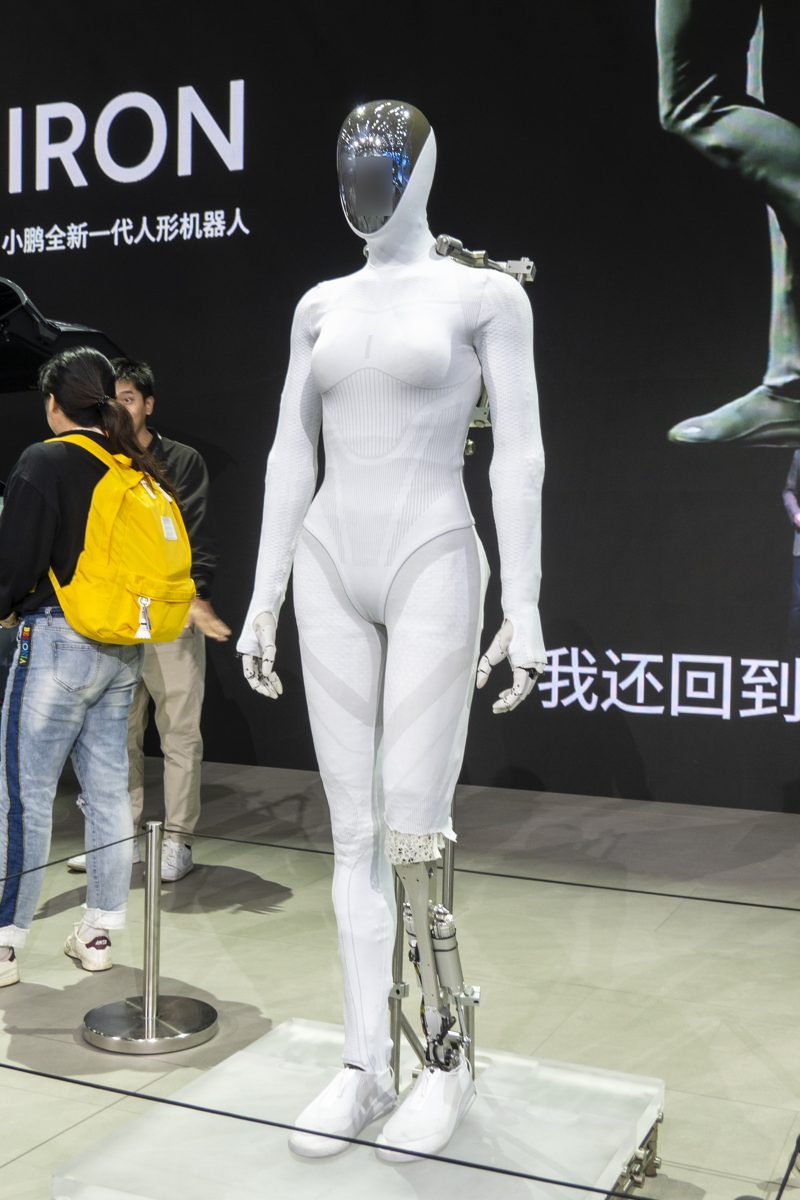
The first-generation IRON appeared at XPeng's AI Day in November 2024; a substantially new generation followed in November 2025. Per XPeng's own September 2026 figures the current robot has 76 degrees of freedom in the body and 21 in each hand, and runs on three of XPeng's own Turing AI chips delivering up to 2,250 TOPS of effective compute. It stands about 178 cm and weighs around 70 kg, and is wrapped in what the company calls a fully enclosed flexible lattice structure — a skin that is both the styling and the safety layer.
Published figures for the earlier generation circulate widely and disagree sharply with these, including claims of around 200 degrees of freedom. Use XPeng's own current numbers; the larger ones appear to count differently or to describe the 2024 machine.
The silicon is the part that does not exist elsewhere in this section. XPeng designs the Turing chip itself, for its cars, its robotaxis and its robot — the same vertical-integration argument Tesla makes with AI5, made by a company that is actually shipping the chip. Inference runs onboard, which XPeng frames as a latency and data-security decision rather than a cost one.
The production line
On 8 September 2026 XPeng opened what it describes as the world's first automated production line for advanced humanoid robots, with core process automation exceeding 80%. That claim is worth stating carefully — UBTECH's Liuzhou plant makes a comparable one — but the substance is not in dispute: a car company has applied automotive-grade process discipline to building humanoids, which is precisely the capability Tesla argues is its own advantage.
Markets and Customers
XPeng expects IRON to reach mass production by the end of 2026, with first deployments in its own stores and campuses doing reception and guidance work, followed by an official launch and deliveries in China and overseas markets in 2027.
Deploying first into your own retail network is a modest, sensible start: the tasks are undemanding, the environment is controlled, and the customer is yourself — the same logic as Tesla testing Optimus in its own plants. It is also not an external customer, and on that measure XPeng is where Tesla is rather than where Figure and Agility are.
What separates the two carmakers is the gap between announcement and line. Tesla has announced capacity for a million robots a year and has not revealed its third generation; XPeng has a line running at over 80% automation, a plant built, a founder-CEO personally in charge, and $900 million of outside money at a $6.3 billion valuation. Neither has a paying customer. The difference is that one of them has a factory making robots today.
Photo: XPeng IRON at Auto Guangzhou 2025, by Tim Wu, CC BY-SA 4.0 via Wikimedia Commons.