
Physical vs. Cloud vs. Hybrid
Back to Server Setup · Budget and Constraints · Sizing · Service Offerings
This is the first decision in server selection: owning hardware, renting cloud instances, or a mix, based on cost, control and compliance needs. The arithmetic side of it — total cost, break-even, existing commitments — is covered under budget and constraints. This page is about the other half: what each model actually gives you, and what it takes away.
The honest starting position is that there is no general answer. Cost, control and compliance rarely point the same way, and a recommendation that ignores two of the three is not a recommendation.
1. What Each Model Really Gives You
- Owning hardware — complete control over specification, placement and lifespan, no per-gigabyte charge for moving your own data around, and predictable cost. In exchange: capital tied up, weeks of lead time, spare parts, someone who can physically attend, and capacity that cannot be handed back. Worth separating on-premises from colocation: you can own the hardware without owning the building, and colocation removes the power, cooling and physical-security problems while keeping the rest.
- Renting cloud capacity — minutes instead of weeks, the ability to stop paying, and managed services that remove work rather than only hardware. In exchange: a bill that rises with success, egress charges, less control over what sits underneath, and a provider whose prices and terms are theirs to change. Worth distinguishing raw instances from managed services — the operational saving is usually in the second, not the first.
- Both — which is what most estates actually run, often without having decided to.
2. Control Is Several Separate Questions
“Control” is used to mean at least four different things, and they do not all favour owning:
- Control of the specification — unusual hardware, a GPU that is not offered, a specific storage controller. Owning wins outright.
- Control of change — nobody reboots your machine for maintenance without asking. Owning wins, and this matters more than people expect for systems with narrow maintenance windows.
- Control of availability — here owning frequently loses. A single owned server has one power supply path, one building and one set of hands. Matching a provider's redundancy with your own hardware is possible and is not cheap.
- Control of the data — who can physically reach the disk, and who can be compelled to hand it over. This is a real distinction, and it is the one that most often decides the question for regulated work.
3. Compliance Usually Narrows Before Cost Decides
Where residency, sovereignty or contractual location requirements apply, they remove options before any comparison happens. Check first whether the provider has a region where you are permitted to operate, whether the managed services you want exist in it, and where support staff are located — because remote access is itself a transfer. It is also worth noting the inverse: a well-run provider region often has certifications and physical security that would be expensive to reproduce in your own building, so compliance does not automatically argue for owning.
4. Hybrid Means Four Different Things
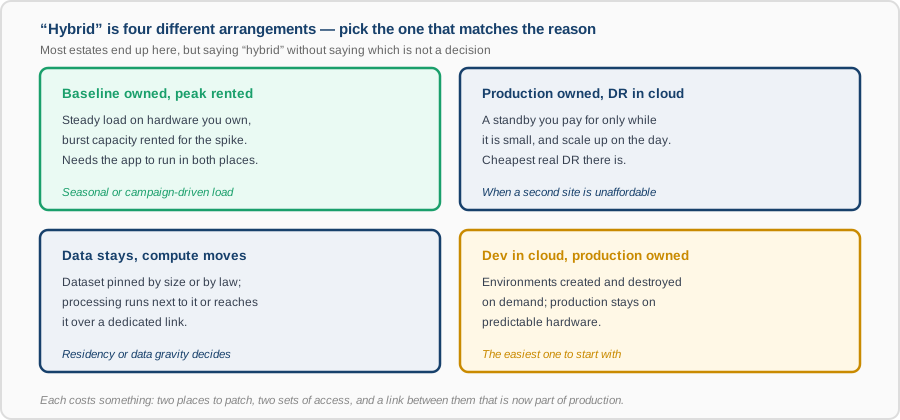
Naming which one you mean is the whole exercise, because each is justified by a different reason and each has a different failure mode. The data gravity pattern in particular is often forced rather than chosen: if the dataset cannot move, the compute goes to it.
Hybrid is also not free. Two environments mean two places to patch, two sets of credentials and access rules, two monitoring configurations, and a network link between them that is now a production dependency with its own failure mode. Budget for that, and prefer patterns where the two halves have clearly separate jobs over ones where a single workload is spread across both.
5. How We Decide
- Eliminate on compliance — what is not permitted is not an option, and this is quick.
- Eliminate on capability — hardware that is not offered, latency that cannot be met, a managed service that does not exist where you need it.
- Check the load shape. Steady and predictable favours owning; bursty, seasonal or unknown favours renting. This does more work than any other single input.
- Do the arithmetic over the realistic asset life — see budget and constraints for what belongs in each column.
- Check the operating model. Who will run this at 03:00, and do they have the skills and the access? An option your team cannot operate is not cheaper.
- Then consider hybrid deliberately, as one of the four named patterns rather than as a compromise.
What You Get
- Options scored against cost, control, compliance and operability, with the eliminations explained rather than assumed.
- Where hybrid is recommended, which pattern and why — plus what it costs to run two environments.
- The exit position for each option: what it would take to reverse the decision in three years, which is the question that turns out to matter.