
Vendor and Licensing Comparison
Back to Server Setup · Licensing Check · Budget and Constraints · Service Offerings
This step weighs providers and licence models — perpetual versus subscription — for real total cost of ownership, not just sticker price. It is the buying-decision counterpart to the licensing check: that one examines licences you already hold and whether they can move, this one is about what to buy in the first place.
1. The Three Models
- Perpetual. Buy once, use indefinitely, pay annual maintenance for updates and support. Higher upfront, lower over a long life — and the important detail: dropping maintenance leaves software that still runs but no longer receives security fixes, which for most products makes it unusable in practice. The perpetual licence is real; running it without maintenance usually is not.
- Subscription. Pay per year or per month; stop paying and you stop using it. Lower to start, no capital outlay, and the price is the vendor's to raise at renewal. The real advantage is optionality — you can leave — and the real risk is that the cost is unbounded over a long life.
- Open source. No licence fee, which is not the same as no cost. The spend moves to your own people, or to a support subscription from a vendor who packages it. Worth evaluating on the same basis as the others rather than treating “free” as the end of the analysis — and worth checking the licence terms themselves, since some now restrict commercial use in ways that older assumptions do not cover.
2. Where Perpetual and Subscription Cross
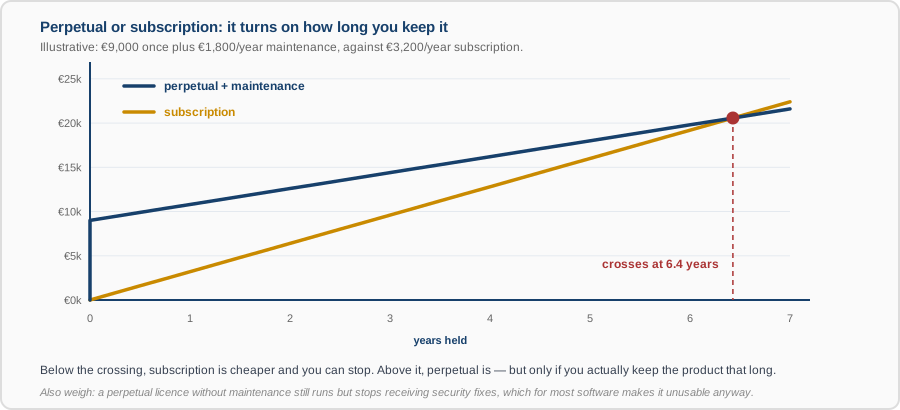
The values are illustrative; the shape is the point. Perpetual is a step then a shallow slope, subscription a straight line, and they cross. Below the crossing, subscription is cheaper and reversible. Above it, perpetual wins — but only if you genuinely keep the product that long, and software you expect to replace in three years should not be bought on a seven-year break-even.
3. What Belongs in the Comparison
- Support tiers. The base tier often excludes the response times you would actually need in an incident. Compare the tier you would really buy, not the cheapest one listed.
- What the unit of licensing is — per core, per socket, per user, per installation. This interacts directly with sizing: a per-core product can make a larger machine cost more in licences than in hardware, and that belongs in the sizing decision rather than after it.
- Non-production environments. Development, test and DR may need licences too, or may be covered — and the difference can double the cost.
- Training and hiring. A cheaper product your team does not know has a cost that appears in delivery time rather than on the invoice.
- The upgrade path. Whether the next major version is included, and whether the migration is a package update or a project.
- Price escalation. What the contract says about renewal increases. An attractive first year with uncapped renewals is a different product from its headline price.
4. Lock-In Is a Cost, So Estimate It
Every choice creates some lock-in; the question is how much and at what price. Estimate, for each option, what leaving would actually take: exporting the data in a usable form, rewriting whatever depends on proprietary interfaces, retraining, running both in parallel during a switch, and any contractual exit terms. Proprietary data formats and deep integration with one provider's managed services are the two that turn a switch into a project.
A high exit cost is not a reason to refuse an option — the managed service that locks you in may also be the one that removes an entire operational burden. It is a reason to know the number before signing, and to prefer the option with a comparable benefit and a lower one.
5. How We Present It
A comparison table over the same period for every option: licence, maintenance or subscription, support tier, non-production, training, and estimated exit cost, with a stated assumption for how long the product will be in service. Where we have a recommendation we give it and say why, and where the decision turns on something only you can weigh — cash flow, risk appetite, an existing relationship — we set out the trade-off rather than deciding it for you.
What You Get
- A like-for-like cost comparison over the expected service life, with every assumption written down.
- The break-even between models, and what would move it.
- Licence units mapped against the proposed sizing, so the two decisions are made together.
- An exit-cost estimate per option.
- A recommendation with its reasoning, and the conditions under which it would change.